
毛骗
Can humanoid robots move beyond the games?_我的网站

A | BANGKOK -- The first group of Thai workers evacuated from Israel after the past few days’ bloody events in southern Israel and Gaza arrived Thursday in the Thai capital of Bangkok, greeted by anxious relatives and senior officials.Hamas militants stormed through a border fence Saturday and killed hundreds of Israelis in their homes, on the streets and at an outdoor music festival. The Israelis have responded with punishing airstrikes and preparations for a possible ground invasion. The conflict has claimed at least 2,600 lives on both sides, including some Southeast Asian workers living in Israel.The 41 Thais who returned home on a commercial flight of the Israeli airline El Al included two men wounded in the violence who had to use wheelchairs to exit the aircraft.Farm laborers from Thailand seek work in more developed countries where there is a shortage of semi-skilled labor — at wages considerably higher than they can earn at home.Tens of thousands of workers in Israel from nations including Thailand and the Philippines send their earnings home to support their families. That money also helps to fire up their native countries’ economies.But the appearance of Thais and Filipinos on the lists of dead, wounded and missing in the past few days is a reminder that foreign workers toil in peril of their lives.About 30,000 Thais are working in Israel, according to the Thai Foreign Ministry, and about 5,000 of them live in the southern area near the border with Gaza.One of them, Katchakorn Pudtason, said his employer at the farm where he worked initially herded all his workers into a bunker when Saturday's attacks took place, but after they left it for lunch they could still hear shooting. As they were being driven back to their workplace, Katchakorn heard more gunshots and felt something hit his knee, he said.“I thought it was a rock but it went through. So I hit the truck and told the driver to drive away,” he said. He added that he was one of four people in the vehicle who suffered injuries that day. He was one of the two returnees who had to use a wheelchair.Thailand's Cabinet ministers for labor, defense and foreign affairs were at Bangkok's international airport for the evacuees' arrival. The government has vowed to look after the evacuees' physical and mental well-being.Foreign Minister Parnpree Bahiddha-Nukara said 5,990 Thais have registered to be evacuated and officials are working around the clock to accommodate them.“We need a Plan B to take out as many people as possible,” said Defense Minister Suthin Klangsaeng. “We will use military aircraft to evacuate people from the high-risk area to a third country, such as (the United Arab Emirates).”The number of Thais affected by the tragedy stood out in lists of non-Israeli nationals affected by the violence: Thailand’s foreign ministry Thursday said 21 Thais are believed dead and 14 wounded. Sixteen were believed to have been taken hostage.Survivor Chatree Chasri left his home in northeastern Thailand in 2019 to work in Israel as an agricultural laborer to pay off debts and provide for his wife and two children back home in Nakhon Phanom. Foreign work is a common path for Thais from the country’s economically disadvantaged rural areas, especially the northeast.Working under a government-to-government agreement, the 38-year-old has been farming tomatoes and cauliflower for the past four years in the southern Israeli town of Mivtahim, less than 10 kilometers (6 miles) away from Israel’s border with Gaza.Despite the occasional shelling and rocket attacks that sent him running for cover, his life at the farm had been OK until Saturday, he said from Israel in a phone interview with The Associated Press. Now he says he wants to come home, and never go back to Israel.Chatree was shot several times in his hip shortly after Hamas launched its rocket attacks and shock ground offensive into southern Israel, killing hundreds of people and capturing more than 100 who were hauled back to Gaza as hostages.Chatree was using a toilet at the farm where he works with other foreign laborers when he suddenly heard gunshots.“The sounds came closer and bullets went through the wall of the toilet,” he said, recalling the moment he was hit. He then saw two gunmen making their way into the workers' living quarters and open fire, so the workers fled outside to hide.Vibhavadi Vannachai, a Thai expatriate who has lived in Israel for nearly two decades and is coordinating with Israeli authorities to help the Thai workers, fears the number of victims may rise.Vibhavadi, originally from Nong Bua Lamphu province in Thailand’s northeast, works as an interpreter in a legal office whose cases mostly involve resolving disputes between Thai workers and their employers.She said abuse and violations of their rights are common, with many bound by years-long contracts but cheated of their wages. Many are forced to work long hours and are beaten if they refuse. Some have to live in “quarters that are not fit for human beings,” she said.Vibhavadi helped find temporary accommodations for Chatree and Padoong Bootmo, a 26-year-old Thai worker shot on Saturday who said the potato and yam farm where he works in Yesha was raided twice by gunmen and then burned down. Padoong said in a phone interview he had been able to send 40,000 baht ($1,100) home each month. He might under the best of circumstances make less than half that doing the same job in Thailand, but he said he doesn’t want to stay in Israel anymore.The killing of at least two Filipino foreign workers underscored the threats also faced by those workers in Israel. About 30,000 Filipinos live and work in the country many as caregivers who look after the elderly, the ill and those with physical disabilities, according to the Philippines' foreign ministry. The huge income they send back home, which last year amounted to an all-time high of $36.14 billion, has helped keep the country’s fragile economy afloat.One of the two Filipinos killed Saturday was a caregiver who was shot with her employer inside their house by Hamas gunmen, according to the Philippines Embassy in Israel. The other was killed under still-unclear circumstances.At least three Filipinos remain missing, embassy officials have said.Still, Foreign Undersecretary Eduardo de Vega said Wednesday that no Filipino has asked to be repatriated from Israel. Jeremiah Supan, a 34-year-old Filipino caregiver in Israel, told The Associated Press in a telephone interview Wednesday that he made it clear to Philippines officials he did not want to return home. As the family breadwinner, he sends his earnings home to enable his 10-year-old son to remain in school and sustain other loved ones."The rocket firings continue” Supan said. “But if I leave, all that assistance that I send to my family back home will be lost.”___Gomez reported from Manila. Associated Press writer Grant Peck contributed.。

B |
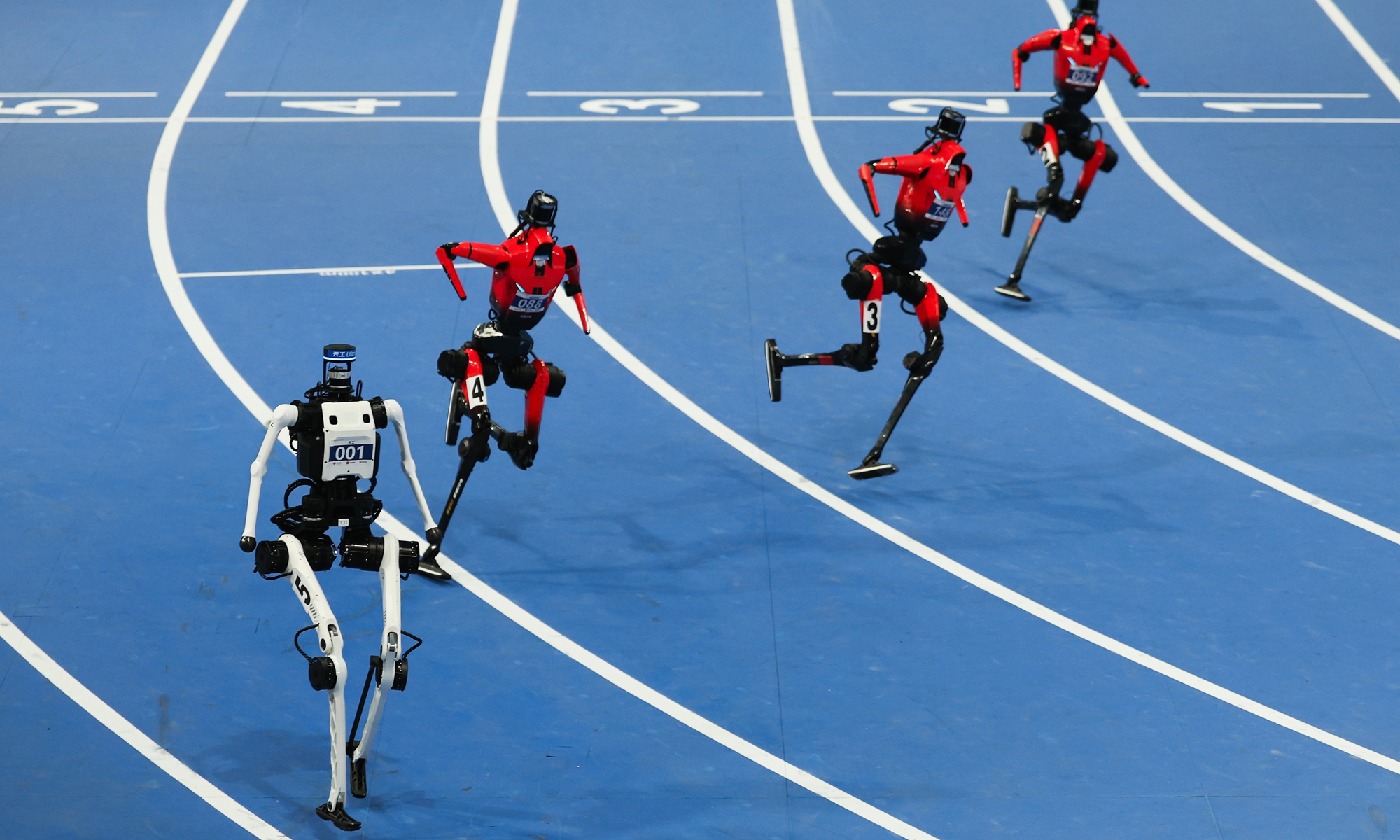
On the blue track inside the National Speed Skating Oval, robots chased each other in the 400-meter race. A sprinting Tien Kung robot was tripped by a rival robot lying on the track but did not fall. Instead, it adjusted its posture in seconds and continued toward the finish line with a result of 38.15 seconds, breaking human 400-meter race world record of 43.03 seconds, held by South African athlete Wayde van Niekerk.
This scene unfolded on Sunday, the first official competition day of the 2nd World Humanoid Robot Games (WHRG). Later that evening, a humanoid robot named Lightning, developed by Honor Co., broke the long-standing human 1,500-meter world record of 3:26 set by Moroccan athlete Hicham El Guerrouj with a time of 2:30.22. Just one night earlier, during the opening ceremony's 100-meter sprint and high jump demonstrations, humanoid robots had already shattered records long held by human athletes Usain Bolt and Javier Sotomayor — merely an appetizer for the five-day sci-fi spectacle.
The Games have attracted 666 teams from 16 countries across six continents, up 138 percent from its inaugural edition. The number of participating robots quadrupled to 2,056, the Global Times learned from the organizing committee.
Yet the biggest change this year was not only the scale, but also the technological maturity. More teams have shifted from remote-controlled robots to fully autonomous systems. Chinese observers, after watching several events, said humanoid robots are no longer limited to simple demonstrations of walking or dancing. Increasingly, they are being tested in environments that demand speed, coordination, perception and decision-making.
From movement to intelligence
Behind the record-breaking performances are a series of technological upgrades. During the running events, Global Times reporters observed that robots were able to make subtle movements around their hip joints while walking, allowing them to maintain balance and produce movements closer to human biomechanics.
Guo Yijie, technical director of Tien Kung Ultra, said the improvement came from advances in hardware design.
"Robot joints have improved in torque and speed. As competitions demand higher power output, the reliability of the main control board, power board and high-power battery discharge capability have become increasingly important," Guo told the Global Times.
According to Guo, the same Tien Kung Ultra robot was used in both sprinting and jumping events. For running, the waist needs rotation to balance the inertia generated by leg movements. For jumping, the upper body requires pitching movement to help the robot achieve greater distance or height, Guo said, noting that these can all be achieved with only slight adjustments to the waist configuration were needed, and it highly demonstrated to the robot design's flexibility.
Besides the hardware upgrades, developments in robots' faster decision-making in "brains' is better showcased in football competitions.
The Booster T2 robot used by many domestic and overseas football teams has increased its onboard computing capability by 10 times compared with the previous generation. The time from recognizing the goal to deciding whether to pass or shoot has been reduced to around 100 milliseconds - faster than the time humans usually need to blink.
Cheng Hao, a technical representative from Boosters Robotics, said the improvement represents an "end-to-end" transformation in embodied intelligence.
"In the past, robots relied on separate steps: perception, planning, decision-making and execution. Each stage was disconnected. Now, with an end-to-end motion foundation model, visual input can directly generate joint control commands," Cheng said.
The newly introduced table tennis and tennis competitions are also testing another important capability: perception.
"Robots are moving from simply recognizing the three-dimensional position of a ball to understanding the movement information of opponents and more complex environments," said Li Yinghui, a postdoc researcher and the leader from the Hong Kong University team at the table tennis event. Such capabilities developed in sports scenarios could eventually be transferred to other scenarios in industries or daily life, Li said.
Beyond entertainment
Though clips from the robot competitions have made a buzz on social media, with some critics from Western media questioning why robots need to dance, play football or compete in athletics while arguing that these activities appear far from everyday needs.
Zhou Changjiu, Vice President of the RoboCup Federation and the Robotics Competition Association of the Asia-Pacific (RCAP), stressed robot sports are not designed for entertainment alone. "Robot competitions are testing the capabilities needed for humanoid robots to enter the real world," Zhou told the Global Times.
Different events evaluate different abilities. Sprinting tests speed, marathons examine battery endurance and energy management, while football provides a comprehensive test because of its dynamic and unpredictable nature, testing intelligence, manipulation, interaction, safety, cost and trust at the same time, Zhou said.
Unlike a single-task demonstration, football requires robots to cooperate. Players must understand their own roles, recognize teammates and opponents, and make collective decisions - a form of swarm intelligence that could become essential when robots work together in homes, factories and emergency rescue environments.
Entertainment, however, can generate business opportunities. Gu Jinghai, brand director of EYOU Robot Co, told the Global Times that the company sold 95,000 integrated joints in China in 2025 and expects sales to exceed 1 million units in 2026. Growth mainly comes from planetary joints used in entertainment robots, while harmonic joints for industrial robots are also expanding steadily, he said.
Jiao Jichao, an executive from UBTECH Robotics, said the criticism that "Chinese robots can only sing and dance" reflects only a temporary stage of development. "Performance and dancing are also real commercial demands, and their existence has value," Jiao said. "Beyond entertainment, Chinese robots are already demonstrating intelligent capabilities that support practical applications in manufacturing, and partnerships with companies including Huawei and Foxconn, where robots have already entered production lines in small-scale applications."
The Outline of the 15th Five-Year Plan for National Economic and Social Development of China stated that the country will construct a comprehensive cultivation system for future industries including the embody intelligence as new economic growth drivers.
Zhou said the development of humanoid robots is not only about individual machines, but about building an entire ecosystem.
China's advantage lies in its complete supply chain, abundant application scenarios and manufacturing capabilities, while the fast growing industry still faces challenges such as the lack of unified standards.
Gu said the company has launched mass production of robotics joint under domestic standard of auto parts.
Robot competitions can help address these issues by creating common standards in areas such as competition rules, robot dimensions, communication systems, batteries and joint modules. "As applications expand, the cost of key robot components will continue to decline," Zhou said.
"Numbers are magic," Zhou said. "If producing one robot costs a huge amount because it is handmade, producing one million robots will completely change the cost structure."
For humanoid robots, the race taking place inside the Ice Ribbon may not ultimately be about who crosses the finish line first. It may be about whether these machines can learn to navigate the far more complicated race outside the stadium - the race into the real world.
。

C |
Current article:http://wynlsz.cesangrangshunzashuangruijiu.pics/0dznen/20260826/41924.html
Published on:03:46:46
我的网站最新文章
- 港股国美零售股价创新低_扩大至_数据
- 到新加坡后怎么办理银行卡?一文看懂全岛银行开户流程
- 检察机关依法分别对吴建东、刘海志、周腾、潘汉胜提起公诉
- 罚款太严重,
- 售价为38.98万元/平行进口方式引入 斯巴鲁WRX Wagon正式上市
- 水位仍在上涨 广西宁明县城水文站25日凌晨预计将出现洪峰
- 三大指数午后集体翻红
- 杭州系统性推进城市更新 城市功能品质整体升级
- 大力优化营商环境 加快高质量发展|河北持续推进信用代证、信用修复、信用融资改革
- 党员活动|守正创新担使命 奋楫笃行开新局
- 士兰微:上半年净利润5.16亿元,同比增长94.84%
- 第十届全国优秀儿童戏剧展演汇聚13部作品 福建话剧《田螺姑娘》入选
- 경북교육청, 2027년도 공간재구조화사업 대상학교 선정 추진
我的网站随机推荐
- 当下最值得关注的PC游戏联名系列盘点
- 乌克兰总统泽连斯基将哈尔科夫地区的局势归咎于全世界
- 8月25日央行开展3860亿元7天期逆回购操作,8月25日央行开展3860亿元7天期逆回购操作
- 9月14日零时起,上海4个中风险区解除管控_黄浦区_南京东路街道
- 耕地复垦让村民信心倍增
- 广东九江大桥沉船事故初查原因:可能为洪水致船员操作失当
- Israel Reportedly Seeks US Go-Ahead to Provide Arab Gulf States With Laser Weaponry
- 先补侧翼再签约!哈登与骑士达成续约共识
- 公司目前在手订单是否充足?源杰科技回应
- 上海文商旅体展联动 大展带动沉浸式体验经济
- China's new ambassador to Australia Liu Jinsong arrives to assume post
- Microsoft推出Windows 10 1809预览版17763.288:修复Operations Center错误
- 土耳其拍案而起,通缉内塔尼亚胡!七国发表声明,要求以色列收手,宏兵灼见,原创 土耳其拍案而起,通缉内塔尼亚胡!七国发表声明,要求以色列收手